Get started
This guide will give you the steps to install MonoGame, get a basic project setup, and build an output that you can publish.
Install
- Get the .NET 10.0 SDK.
- Test that dotnet is installed correctly:
dotnet --version - Get the MonoGame templates:
dotnet new install MonoGame.Templates.CSharp
Create a new game
Replace MyGame with your game’s name in the following two command:
dotnet new mgdesktopgl -o MyGame
cd MyGame
Run
dotnet run
Publish
You can publish on Windows, Mac, and Linux using:
dotnet publish -c Release -r win-x64 -o artifacts/windows --self-contained
dotnet publish -c Release -r osx-arm64 -o artifacts/osx-arm64 --self-contained
dotnet publish -c Release -r osx-x64 -o artifacts/osx-x64 --self-contained
dotnet publish -c Release -r linux-x64 -o artifacts/linux --self-contained
You’ll find the output in:
artifacts/windows
artifacts/osx-arm64
artifacts/osx-x64
artifacts/linux
Macs have shipped with Apple Silicon since 2020, so osx-arm64 is the build most of your players need. An osx-x64 build still runs there through Rosetta, though it’s slower and Rosetta isn’t installed by default.
Zipping a folder is enough to share the Windows and Linux builds. macOS needs more. The game has to be an .app bundle to be double-clickable, and every Mach-O binary inside that bundle has to be signed, since Apple Silicon kills any process whose images aren’t. MonoGame covers the bundle layout in Package games for distribution.
MonoGame Content Builder Editor
The editor ships as a local dotnet tool, so restore it once per project:
dotnet tool restore
Then launch it from the root folder of your project:
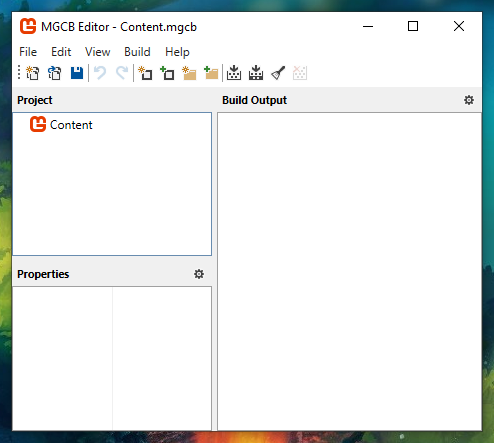
dotnet mgcb-editor Content/Content.mgcb
dotnet build restores the tools too, so you can skip the restore if you’ve already built the project once.
You should see this window appear:
Read more
You can read more getting started info from the official MonoGame docs.
Now that you have a project, the next step is to setup a development environment. Developing with Visual Studio Code.
Edit this page on GitHub